Personalized Email Marketing Strategies

West Palm Beach businesses have no shortage of competition for customer attention. From local service providers and professional firms to hospitality, retail, and growing ecommerce brands, businesses need more than a general message sent to an entire contact list. Customers expect communication that feels relevant to their interests, needs, and previous interactions with a brand.

That makes personalization an important part of a modern email strategy. When businesses understand who their customers are and what they care about, they can create more meaningful communications that encourage people to open, click, and convert. At The AD Leaf West Palm, we help businesses replace an unclear marketing strategy with a customized marketing roadmap built around their audience and business goals.

If your email marketing needs a clearer direction, connect with The AD Leaf West Palm to discuss your marketing goals.

Start With a Better Understanding of Your Audience

A common email marketing problem is treating every subscriber the same. Your audience may include new prospects, returning customers, highly engaged subscribers, and people who have not interacted with your business in months. Each group may need a different message.

Customer segmentation allows you to organize these contacts according to meaningful characteristics and behaviors. You might separate customers by previous purchases, service interests, engagement levels, location, or where they are in the buying process.

For a West Palm Beach business, these distinctions can create opportunities for more relevant communication. A local service company could send different messages to homeowners interested in different services. A retailer could recommend products based on previous purchases. A professional business could create separate campaigns for prospects and existing clients.

According to Mailchimp, its customers saw up to a 24% higher click rate when they segmented campaigns compared with campaigns that did not use segmentation. Individual results vary, but the statistic demonstrates the potential value of delivering more relevant content.

Make Personalization About More Than a Name

Personalization does not begin and end with putting a customer’s first name in the subject line. Effective email personalization strategies use information about customer interests and behavior to make the entire message more useful.

Consider what your subscribers do before deciding what to send them. Which emails do they open? What links do they click? Which services or products do they explore? Have they purchased from you before? How recently did they interact with your business?

These questions can guide personalized marketing tactics based on actual behavior instead of assumptions.

For example, someone who repeatedly visits a specific service page could receive helpful information about that service. A recent customer could receive follow-up recommendations or educational content. An inactive subscriber could receive a re-engagement message designed to bring them back into the conversation.

These email personalization strategies can make targeted email campaigns more relevant while supporting engagement optimization throughout the customer journey.

Our email marketing services can help your business turn audience information into a more organized and purposeful campaign strategy.

Build Targeted Email Campaigns Around Customer Needs

Personalization becomes more effective when every campaign has a specific purpose. Before sending an email, determine what you want the recipient to do next.

That action might involve scheduling a consultation, visiting a service page, making a purchase, downloading information, or contacting your business.

Once the objective is clear, personalized marketing tactics can shape the content around the audience receiving it. Subject lines, offers, images, recommendations, calls to action, and educational content can all change based on customer interests.

Automation can take this strategy further. A welcome email can introduce a new subscriber to your brand. A follow-up can reach someone after an inquiry. A post-purchase message can provide helpful information after a sale. A re-engagement campaign can reconnect with subscribers who have stopped interacting.

These targeted email campaigns allow businesses to communicate with customers at meaningful points instead of relying on one broad message.

For additional strategy ideas, explore Ways Email Marketing Can Impact Your Campaign Strategy.

Turn Email Personalization Into a Customized Marketing Roadmap

Having customer information is useful, but information alone does not create a marketing strategy. Businesses need a process for deciding which audiences to prioritize, what messages to create, and how to measure the results.

That is where a customized marketing roadmap can make a difference.

At The AD Leaf West Palm, we can start by identifying your business objectives and evaluating your current marketing efforts. From there, we can identify opportunities for customer segmentation and determine which email personalization strategies align with your goals.

Your roadmap might include a welcome sequence, educational campaigns, promotional messages, customer retention emails, or re-engagement campaigns. Each campaign should connect to a larger objective rather than operate as an isolated email.

We can also look at how email works alongside your website, social media, content marketing, and advertising. A consistent strategy across these channels creates a stronger customer experience and gives your audience more opportunities to engage.

Ready to create a clearer direction for your email marketing? Talk with The AD Leaf West Palm about developing a customized marketing roadmap.

Use Results to Improve Engagement

Personalization should continue after you press send. Your campaign results can provide valuable information about what your audience actually wants.

Track clicks, conversions, engagement rates, unsubscribes, and other meaningful performance indicators. A/B testing can also help you compare subject lines, offers, content, calls to action, and timing.

These insights allow you to refine personalized marketing tactics and improve engagement optimization over time. If one customer segment consistently responds to educational content while another responds to promotions, your future targeted email campaigns should reflect those differences.

The goal is not to send more emails. The goal is to make each email more useful.

Why The AD Leaf

At The AD Leaf West Palm, we believe effective email marketing starts with a strategy that connects your business goals with your customers’ needs. Sending more emails does not automatically create better results. Businesses need the right audience, the right message, and a clear reason for every communication.

Our team can help develop personalized marketing tactics, customer segmentation strategies, and targeted email campaigns designed around your business. Through data, creative strategy, and ongoing engagement optimization, we help businesses create email personalization strategies that support stronger customer relationships and more opportunities for conversion.

If your West Palm Beach business is ready to move beyond generic email marketing, contact The AD Leaf West Palm to build a customized marketing roadmap designed around your audience and goals.

Transform Your Q4 Strategy: Using AI Virtual Assistants to Boost Lead Generation During the Holidays

As the final quarter approaches, high-end brands and professional service firms throughout Palm Beach County are shifting their focus to year-end growth. In the affluent and discerning market of West Palm Beach, standard promotional tactics simply do not meet client expectations. To secure maximum profitability before the year closes, your Q4 marketing strategies must reflect sophistication, precision, and an unwavering commitment to client service. Waiting until the holiday rush begins to optimize your digital presence means leaving valuable executive and consumer revenue on the table.


Developing an elite Q4 strategy requires more than seasonal advertising; it demands an intelligent digital environment that mirrors white-glove service. When year-end demand surges, integrating AI virtual assistants allows your business to deliver immediate, expert-level engagement, securing a substantial holiday marketing boost while maintaining the polished brand image your clientele expects.


Why Palm Beach County Brands Need a Bespoke Holiday Focus


The closing months of the year bring an influx of seasonal residents, holiday investors, and businesses looking to allocate remaining budgets. However, because competition across South Florida intensifies during this period, cutting through the digital noise requires deliberate planning. This exact reality is why enterprises must develop a marketing strategy specifically for the holidays instead of relying on generalized, year-round templates.


Consider the expectations of the West Palm Beach demographic: whether they are booking premium advisory services or shopping for luxury year-end assets, they demand immediate, frictionless interaction. If a high-value prospect encounters a slow response time on your website, they will quietly move on. By deploying AI virtual assistants, you eliminate lag, qualify inquiries gracefully, and uphold a standard of responsiveness that sets your brand apart.


Delivering White-Glove Engagement Through Intelligent Tools


The implementation of AI virtual assistants has become a hallmark of forward-thinking corporations. Far from rudimentary automated text boxes of the past, today’s advanced artificial intelligence utilizes sophisticated natural language processing to converse smoothly, address complex service inquiries, and orchestrate seamless handoffs to human strategists.


Data highlights the profound impact of responsive digital architecture during high-stakes seasons. According to insights from Forrester Research, businesses utilizing advanced automated assistance see superior client satisfaction and accelerated conversion velocity during peak planning quarters. When you integrate AI virtual assistants into your web presence, you ensure that every seasonal visitor receives immediate, tailored attention, protecting your conversion rates.


[In-text Image Placeholder: Diagram illustrating executive-level automated lead routing for high-value services]


Advanced Lead Generation Tactics for Fourth-Quarter Success


When you are marketing strategies to finish out your 4th quarter with a bang, operational excellence dictates your final revenue numbers. Effective lead generation tactics during Q4 must prioritize speed, accuracy, and elegance. Here is how leading firms leverage digital tools to close strong:


  1. Discreet Lead Triage: High-volume traffic requires sophisticated sorting. AI tools instantly separate high-net-worth prospects from standard queries, protecting executive time.
  2. Concierge-Level Guidance: Virtual assistants act as digital hosts, recommending premium year-end packages or consultation slots based on real-time dialogue.
  3. Frictionless Data Collection: Replacing cumbersome, multi-field forms with natural, conversational data gathering drastically increases client participation.


Synchronizing Automated Tools with Multi-Channel Outreach


No digital asset operates effectively in isolation. To maximize your annual return, your automated systems must work in absolute harmony with your broader outbound campaigns. Reviewing the ways email marketing can impact your campaign strategy demonstrates how vital it is to channel executive email outreach into an optimized conversion environment. When your targeted year-end email updates land in client inboxes, the resulting traffic encounters a responsive, intelligent platform ready to convert.


Pairing sophisticated email segmentation with modern automation in marketing builds a self-sustaining revenue engine. The outreach initiates the relationship, and the AI handles immediate engagement and qualification. This seamless synchronization protects your profit margins during the most critical quarters of the year.


Refining Your Q4 Strategy Before Year-End Demands Peak


The least effective time to experiment with new Q4 marketing strategies is amidst the peak of holiday activity. Market leaders build, test, and polish their automated architectures well in advance. By introducing AI virtual assistants early, your system adapts smoothly to user trends and inquiries before the seasonal rush hits its stride. This preparation guarantees your overarching Q4 strategy performs flawlessly under pressure.


Why The AD Leaf West Palm Beach?


At The AD Leaf Marketing Firm, we understand the prestige and performance required to succeed in the West Palm Beach market. Navigating fourth-quarter business goals demands a blend of localized insight and elite technical infrastructure. Our team specializes in engineering custom Q4 marketing strategies that integrate powerful AI virtual assistants directly into your core client acquisition channels. By deploying innovative lead generation tactics and streamlined automation in marketing, we help Palm Beach County brands capture maximum value. Let us partner with you to ensure your business finishes the year with distinction and maximum profitability.

Holiday Traffic Only Matters If It Converts: What West Palm Beach Businesses Need to Fix Before Q4

Holiday Traffic Only Matters If It Converts: What West Palm Beach Businesses Need to Fix Before Q4

Better analytics and similar revenue is the outcome for West Palm Beach businesses that invest in Q4 marketing without addressing the conversion gaps on their website first. The traffic arrives, the sessions look good in the dashboard, and the phone does not ring at the rate the numbers should produce. The problem is almost never the quality of the traffic. It is the friction between a visitor who arrived with intent and a website that made taking action harder than it should have been. Fixing that friction before the holiday traffic arrives is the highest-ROI action most local businesses can take right now.

Mobile Performance Is the Non-Negotiable Starting Point

The majority of local search traffic in the Palm Beach market arrives on mobile devices, and during Q4 that percentage increases further as consumers search while traveling, shopping, and attending events. A page that takes more than three seconds to load on a mobile connection loses a significant share of those visitors before they have read the headline. Google’s Core Web Vitals measure mobile page performance as a direct ranking signal in local search, which means a slow mobile page costs you both the ranking and the conversion simultaneously. Our web team treats mobile page speed as a first-priority audit item in every Q4 preparation engagement, because everything else on the conversion path is irrelevant if the page does not load before the visitor moves on.

Promotion Clarity Across Every Channel Is Not Optional

West Palm Beach businesses running Q4 promotions frequently make the same mistake: the offer exists somewhere on the website, but it is not visible in the moments and places where the consumer is most likely to act. A holiday promotion that appears only as a footer banner on one page, was posted once to Instagram two weeks ago, and is absent from paid search ads is not a coordinated campaign. It is a discount that your most loyal and persistent customers might eventually find.

Promotion clarity in Q4 means the offer is the first thing a visitor sees when they land on the relevant page, it is featured actively in Google Business Profile posts, it is the subject of a dedicated email to your existing list, it is reflected in your paid ad copy, and it is what your social content is consistently reinforcing throughout October and November. That coordination is the difference between a promotion that produces measurable Q4 revenue and one that gets lost in the noise of the Palm Beach market during its most competitive window. Our digital marketing team coordinates these layers across every channel so that the message is consistent and present wherever your prospective customers are looking.

Contact Friction Is Immediate and Measurable Revenue Loss

The most common and most fixable conversion problem for West Palm Beach local businesses is the friction between a visitor who is ready to take action and the business’s ability to receive it cleanly. A contact form with seven required fields before a simple inquiry can be submitted. A phone number visible only in the footer that does not link to a dialer on mobile. A chat widget showing offline during business hours. An email address that opens a desktop mail client when tapped on a phone. Each of these is a conversion that did not happen and a lead that went to a competitor whose contact path was simpler.

Friction audits are among the fastest-turnaround improvements available in digital marketing because the problems are identifiable, the fixes are implementable quickly, and the impact shows in the data within the first month. Reducing a contact form from seven fields to three, adding a visible click-to-call button in the page header, and ensuring chat or text messaging is active during business hours are the kinds of changes that produce measurable increases in contact rate without requiring a full redesign. Our web services include friction auditing and rapid implementation specifically for businesses preparing for peak season.

Retargeting Turns Holiday Interest Into Holiday Revenue

Most visitors who arrive at a West Palm Beach business website during Q4 with genuine purchase intent do not convert on the first visit. Some are still comparing options. Some need to check availability or budget. Some got interrupted mid-session. Without a retargeting campaign, those visitors leave and are effectively gone. With one, your business remains visible to them across Google Display Network and Meta as they continue their research, with messaging designed specifically for the visitor who has already shown interest but has not yet reached out.

Holiday retargeting campaigns consistently produce the highest return on ad spend in the Q4 program because the audience is pre-qualified by demonstrated intent. Setting them up now, before the traffic volume that makes them most valuable arrives, ensures the campaigns have the audience data and the optimization history to perform when it matters most. Our AI marketing tools produce the ad creative and copy variations that keep retargeting audiences engaged across a multi-week Q4 window without fatigue. Call 321.255.0900 or reach out through our contact page to talk through what Q4 conversion optimization looks like for your West Palm Beach business before the window to prepare it properly has closed. You can also review our case studies to see how other Palm Beach area businesses have improved conversion rates and closed stronger Q4s.

Year-End Urgency and Next-Year Planning: How West Palm Beach Businesses Should Use Q4

Year-End Urgency and Next-Year Planning: How West Palm Beach Businesses Should Use Q4

Q4 delivers two distinct marketing opportunities that run simultaneously, and the West Palm Beach businesses that understand both close the year with stronger revenue and start the next one with momentum already built. The first is year-end urgency: the window when consumers are actively spending, businesses are motivated to close revenue gaps before December 31, and the pressure of a deadline makes decisions happen faster. The second is next-year planning: the period when every business is setting its marketing budget, selecting its vendors, and deciding what it is going to do differently in the coming year. A well-run Q4 marketing program serves both at the same time.

Year-End Urgency Shortens the Sales Cycle Without Manufacturing Pressure

One of the most valuable things about Q4 for West Palm Beach businesses is that the urgency is externally generated and real. A homeowner thinking about renovating before the seasonal return of their Palm Beach neighbors has a real timeline. A business owner trying to close a revenue gap before year-end is genuinely motivated to make decisions faster than they would in July. A consumer searching for holiday gifts has a hard deadline approaching. This urgency is not something a marketing campaign has to create; it is something an effective campaign has to be ready to capture when the consumer arrives with it already present.

Capturing that urgency requires that the promotion is visible, the offer is clear, and the next step is easy. A year-end promotion that exists only as a buried banner on the website and a single social post is not a strategy. A coordinated effort where the same offer is visible in paid search, in the email campaign to your existing list, in social content, and on the relevant service or product page is a strategy that turns real consumer urgency into real business outcomes. Our digital marketing team coordinates these layers so your Q4 message is consistent and omnipresent across every channel simultaneously, and our AI marketing tools make the volume of content Q4 coordination requires actually achievable.

The Next-Year Planning Conversation Is Where Annual Relationships Are Won

New year resolutions concept with wooden blocks showing 2027 and a red heart next to a spiral notebook on a warm yellow surface background

While year-end urgency produces near-term revenue, the more strategically valuable Q4 opportunity for West Palm Beach businesses is the next-year planning conversation. Every business in the Palm Beach market is setting its marketing budget for the coming year right now, and the vendors and agencies that get into those conversations in Q4 are the ones that secure annual engagements. Those that show up in January, after budgets have already been allocated and decisions have already been made, are competing for whatever is left over.

The most effective approach in this environment is to offer something genuinely useful in Q4 regardless of whether a prospect is ready to sign: a marketing budget planning conversation, an honest assessment of what channels make sense for their business type and market size, or a clear explanation of what realistic outcomes look like at different investment levels. A West Palm Beach business owner who works through that conversation with you has already experienced what working with you is like, which is the most powerful differentiator available in any service business. Our team at The AD Leaf West Palm has these conversations regularly and without a sales script attached, because the quality of the thinking is the differentiator. Reach out through our contact page or call 321.255.0900 to start that conversation.

Service Comparisons Happen in Q4: Be Ready for the Evaluation

Businesses evaluating marketing agencies in Q4 are not browsing; they are making real decisions on real timelines. They are comparing options, reading case studies, and choosing the partner they will work with for the next twelve months. The agencies that win these decisions in the Palm Beach market are the ones that have built clarity and transparency into their marketing before the evaluation begins: clear descriptions of what each service delivers, honest explanations of what realistic results look like and over what timeline, and specific examples from businesses that resemble the prospect’s own.

Our case studies are built around this kind of specificity, and our services pages explain what is included and how results are measured rather than relying on vague claims. That transparency reflects how we work with clients, and it is what makes the Q4 evaluation process an opportunity rather than a pressure. The ROI of Q4 investment extends well beyond December: the SEO content published now will produce traffic for months, the client relationships established during Q4 become annual engagements, and the campaign data generated during the holiday season improves performance for every campaign that follows. Review our AI marketing services to see how we integrate AI-driven tools across every channel we manage, and reach out when you are ready to talk about what next year looks like. You can also explore our web and programming services as part of a comprehensive Q4 and new-year strategy.

Why West Palm Beach Businesses Need Q4 Marketing in Place Now

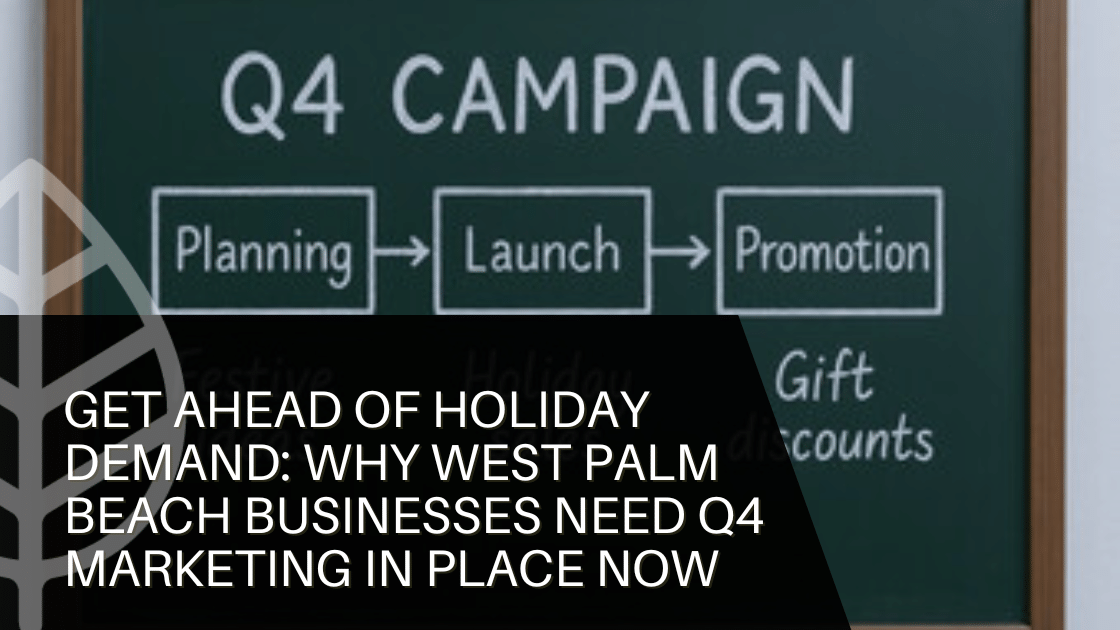
Get Ahead of Holiday Demand: Why West Palm Beach Businesses Need Q4 Marketing in Place Now

The businesses that close Q4 strong in West Palm Beach are not the ones that started thinking about holiday marketing in November. They are the ones that had their seasonal content indexed, their campaigns running, and their conversion paths ready before the holiday demand spike arrived. The difference between those two outcomes is not budget or strategy quality. It is timing. And the timing window for building Q4 marketing that actually performs is now, not when the season has already begun.

The Palm Beach Market’s Q4 Is Distinct

West Palm Beach and the surrounding Palm Beach County market experiences a Q4 dynamic that differs from most of the country in ways that make earlier preparation even more valuable. Seasonal residents from the northeast and midwest begin returning in October, bringing a significant influx of higher-income consumers who are re-establishing local service relationships across every category: healthcare providers, home services, restaurants, personal services, and professional services all see demand increase as the seasonal population returns. At the same time, tourism climbs as Florida’s weather becomes a national selling point during the fall and winter months.

This means West Palm Beach businesses are competing for a larger and more active consumer base during Q4 than at any other point in the year, and that competition includes both local businesses and national brands running holiday campaigns with significant budget. The advantage for local businesses is local relevance, local trust, and local search visibility that national brands cannot replicate. Building that visibility before the seasonal influx arrives is what determines whether local businesses capture the demand or watch it go to whoever prepared better. Our digital marketing programs are built specifically for this kind of market-timed competitive positioning.

Seasonal Content Needs Time to Rank Before the Season Peaks

The most consistent and costly Q4 mistake West Palm Beach businesses make is treating holiday content as something to produce once the holiday season is obviously underway. Google indexes and evaluates new pages over days and weeks, and assigns rankings based on accumulated relevance and authority signals that take time to build. A seasonal landing page targeting holiday gift searches published in October has a meaningful probability of ranking for those terms by mid-November. The same page published in late November will not rank until after the peak traffic window has already closed.

This applies to every piece of Q4 content: holiday service pages, gift certificate landing pages, year-end promotion blog posts, and seasonal FAQ content all need to be published with enough lead time for the search engines to evaluate and rank them before the demand spike arrives. Our content team plans and executes Q4 seasonal content on a timeline that accounts for this indexing reality, not one that starts when the holiday decorations go up in stores.

Conversion Readiness Has to Come Before the Traffic

A West Palm Beach business that drives holiday traffic to a poorly converting website is spending marketing budget to confirm that the website does not work. The conversion gaps that cause this, slow mobile load times, buried contact information, vague calls to action, forms with too many fields, and phone numbers that are not click-to-call on mobile, are not complex to fix, but they take time to address properly. Addressing them in November, after the traffic has already started arriving, means the first weeks of peak season are producing lower returns than they should while the fixes are being implemented.

Our web team conducts conversion audits and implements fixes as part of Q4 preparation so that when the holiday traffic arrives, it is landing on pages built to capture it. The return on fixing conversion friction before peak season is immediate and measurable: higher contact rates from the same traffic, better ROI on every paid click, and a better foundation for the retargeting campaigns that recapture visitors who did not convert on the first visit.

Paid Advertising Costs Rise in Q4: Be Structured Before They Do

Cost per click on Google and Meta increases consistently throughout Q4 as the holiday advertising inventory fills with competing campaigns. The businesses that get the best return during this period are not spending the most; they are the ones that entered the season with well-structured campaigns, tightly matched ad copy and landing pages, and retargeting sequences already in place for warm audiences. Building that structure in October, before costs climb and before your competitors have saturated the audience, produces materially better performance per dollar than the same structure built in November under time pressure.

Our paid advertising programs are designed around conversion from the start, not optimized for it after the budget has already been spent on broad awareness. Combined with our AI marketing tools that accelerate content production and campaign iteration during the high-demand Q4 window, we give West Palm Beach businesses the infrastructure to compete effectively at every budget level. Call 321.255.0900 or visit our contact page to start the conversation about what Q4 preparation looks like for your business specifically. Review our case studies to see how other Palm Beach area businesses have used proactive Q4 marketing to close their strongest quarters.

Digital Marketing for West Palm Beach Small Businesses: Where to Start in 2026

Digital Marketing for West Palm Beach Small Businesses: Where to Start in 2026

Most small business owners in West Palm Beach know they need to do more with digital marketing. Fewer of them have a clear picture of where to start, what order to build in, and what they can reasonably expect from each channel at different stages of investment. The answer they usually get from agencies is not helpful: everything matters, you need it all, here is a package price. That is not a strategy. It is a services menu.

This piece gives you a practical starting framework based on what actually works for small businesses in Palm Beach County, in what order, and why. The right sequence depends on where your business is right now and what your goals look like over the next 12 months, so this is a framework to adapt rather than a fixed prescription.

Start With Your Foundation: What You Cannot Skip

Before any channel strategy matters, three things need to be in place. Without them, every dollar you spend on digital marketing is less effective than it should be.

A Website That Converts

Your website is where almost every digital marketing channel sends traffic. If it loads slowly, does not work on mobile, has unclear calls to action, or does not clearly communicate what you do and why someone should choose you, every other marketing investment produces worse results than it should. A conversion-focused website does not need to be expensive or elaborate, but it does need to be fast, mobile-optimized, clear on what you offer and who you serve, and structured to make it easy for a visitor to contact you or take the next step. Our web design and programming team builds and maintains sites for Palm Beach County businesses with conversion as the primary design goal. This is the single most leveraged investment most small businesses can make before spending on any paid or organic traffic channel.

A Complete Google Business Profile

For local service businesses in West Palm Beach, your Google Business Profile is often the first thing a potential customer sees. It determines whether you appear in the local map pack, what information is visible before someone clicks to your website, and how easily customers can call you, get directions, or read your reviews. A complete, accurate, actively managed GBP is free and produces a disproportionate return relative to the effort required. If yours is incomplete, has outdated hours or photos, or has not had a new review in six months, fixing that is a higher priority than most paid channels. Our local marketing team handles GBP setup and management for Palm Beach County businesses as part of every local SEO engagement.

Conversion Tracking

If you cannot measure which marketing activities are producing leads and customers, you cannot make good decisions about where to invest. Setting up basic conversion tracking, form submissions, phone call tracking, and purchase confirmations, before you spend on paid channels is essential. Without it, you are running campaigns blind and optimizing based on clicks and impressions rather than actual business outcomes. This is one of the most common gaps in small business digital marketing setups and one of the fastest to fix with the right help.

Channel Priority: What to Build in What Order

A captivating scene showcasing the core elements of digital advertising and marketing, designed to resonate with a target audience of marketing professionals, business owners.

Google Ads for Immediate Lead Generation

If you need leads now and your foundation is in place, Google Ads is typically the fastest path to measurable results for West Palm Beach small businesses. It puts you in front of people who are actively searching for what you offer, and when structured correctly, it produces trackable leads within days of launch. The caveat is that it requires active management to perform well. Campaigns that are set up and left alone tend to drift toward inefficiency as broad match settings expand keyword targeting into irrelevant searches and quality scores decline. Professional management of a modest budget typically outperforms self-managed campaigns with a larger budget. Start with search campaigns targeting your highest-intent keywords, verify your conversion tracking is working, and treat the first 60 to 90 days as a data-gathering and optimization period rather than expecting peak efficiency from day one.

Local SEO for Compounding Organic Growth

Local SEO takes longer than paid media to produce results, but the returns compound in a way that paid media does not. A page that ranks in the top three of the local map pack for a high-intent keyword drives leads continuously without per-click cost. Building that position requires consistent investment in on-page optimization, citation consistency, review generation, and local content, but once established it is far more durable than a paid campaign that stops producing the moment the budget runs out. For most West Palm Beach small businesses, local SEO should begin at the same time as paid search, with the expectation that paid delivers short-term results while organic builds the longer-term asset. Our West Palm Beach marketing services integrate both channels from the start.

Content Marketing for Authority and Long-Tail Traffic

Content marketing is the investment that most small businesses defer longest and that tends to produce some of the highest long-term ROI when done consistently. Blog posts and resource pages that answer the questions your target customers are asking build topical authority in your category over time, drive organic traffic from searches that are too specific for service pages to rank for, and increasingly improve your visibility in AI-powered search tools that pull from authoritative content when generating answers. The right content strategy for a West Palm Beach small business is not publishing three posts a month on generic industry topics. It is identifying the specific questions your target customers ask before they contact a business like yours and building content that answers those questions more completely than anything else available.

Email Marketing for Customer Retention and Repeat Business

Most small businesses underinvest in the customers they already have relative to the effort they put into acquiring new ones. Email is the highest-ROI channel for staying in front of existing customers, driving repeat business, and generating referrals. A basic email program, welcome sequence for new contacts, periodic value-driven newsletters, and reactivation campaigns for lapsed customers, does not require a large budget and produces returns that are directly visible in repeat purchase rates and referral volume. Once your acquisition channels are working, building a consistent email program on top of them is one of the best uses of an additional marketing budget increment.

What to Expect from AI Marketing in 2026

AI marketing tools are genuinely useful for West Palm Beach small businesses in specific applications: paid search optimization, email personalization, content production acceleration, and AI search visibility. They are less useful as a wholesale replacement for marketing strategy and human judgment. The businesses getting real results from AI in South Florida are using it to improve the performance of channels they have already established, not as a shortcut past the foundational work that all those channels require.

The area where AI is most important to pay attention to right now, even for businesses at an early stage of digital marketing investment, is AI search visibility. Answer engine optimization does not require a large budget, but it does require building the right structured data and content signals before your competitors do. The window for building early authority in AI search in the Palm Beach County market is still open, but it will not be open indefinitely.

The AD Leaf works with small businesses across West Palm Beach, Boca Raton, Palm Beach Gardens, and Wellington to build digital marketing programs that are sequenced correctly for their stage of growth. If you want a straightforward assessment of where your business stands and what to prioritize next, call us at 321.255.0900 or contact our team to start the conversation.

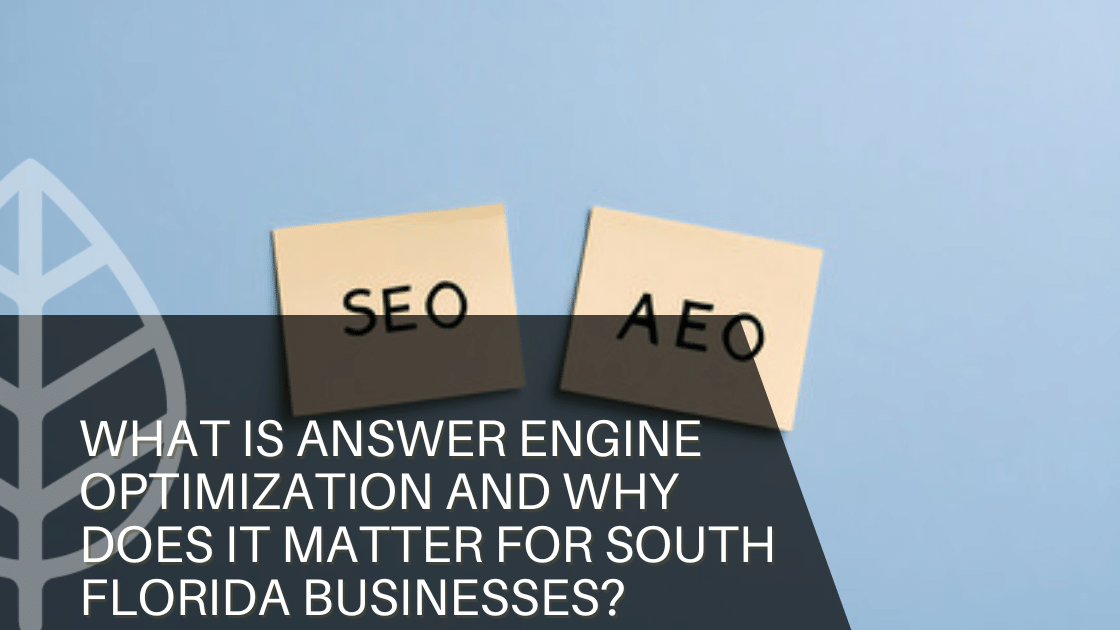
What Is Answer Engine Optimization and Why Does It Matter for South Florida Businesses?

What Is Answer Engine Optimization and Why Does It Matter for South Florida Businesses?

Search engine optimization has been the foundation of digital marketing strategy for two decades. The goal was straightforward: rank your website near the top of Google’s search results for the queries your target customers were making, and capture a portion of the traffic those rankings produce. That model is not going away, but it is being meaningfully disrupted by a change in how a growing share of searches are answered.

When someone asks ChatGPT which accountant to hire in West Palm Beach, or uses Google’s AI Overview to find a plumber in Boca Raton, or asks a voice assistant for the best restaurant near CityPlace, they are not browsing search results. They are receiving a direct answer from an AI system that has already evaluated the available options and selected the ones it considers most credible and relevant. If your business is not in that answer, you did not lose to a competitor who ranked above you. You were not considered at all.

Answer Engine Optimization is the discipline of building your business’s digital presence so that AI-powered search tools and voice assistants confidently include you in their answers. It is one of the most important emerging areas of digital marketing for South Florida businesses, and most local businesses have not yet started paying attention to it.

How Answer Engines Are Different from Search Engines

Traditional search engines like Google rank web pages and present a list of results for users to evaluate. The user does the selection work. Answer engines, including AI assistants like ChatGPT and Perplexity, and AI-powered features like Google’s AI Overviews, do the selection work for the user. They evaluate available sources, synthesize the relevant information, and present a single answer or a short list of recommendations. The user’s job is to decide whether to act on what they receive, not to evaluate ten options and choose.

This means that ranking fifth on a search results page still gets you some visibility. Not appearing in an AI-generated answer gets you nothing. The winner-take-most dynamics of AI search are more extreme than traditional search, which is why businesses that build the right foundation now are positioned to capture a disproportionate share of AI-generated referrals in their category and geography.

What AEO Involves in Practice

Structured Data and Schema Markup

Schema markup is code on your website that tells AI systems and search engines specific, structured facts about your business: your name, address, phone number, hours, service categories, reviews, and areas of expertise. Without it, AI systems have to infer this information from the surrounding text, which is less reliable and less likely to result in your business being surfaced. With it, you give AI systems clean, machine-readable data that makes your business easier to evaluate and include. This is one of the most technically specific parts of AEO and one of the most frequently missing from local business websites in Palm Beach County. Our AEO services include schema implementation as a core deliverable.

Question-Formatted Content

AI systems are optimized to answer questions. Content that directly and completely answers a specific question is more likely to be cited by an AI system than content that discusses the same topic without ever clearly stating the answer. This means building content around the actual questions your target customers are asking, framed as questions, with direct answers that do not bury the most useful information in several paragraphs of context. FAQ pages, resource articles, and blog content structured this way perform differently in AI search than traditional keyword-optimized content. Our content team builds question-format content specifically calibrated for AI search performance.

Entity Consistency

An entity is how AI systems represent your business: a coherent, identifiable organization with specific attributes. If your business name, address, and phone number appear differently across your website, your Google Business Profile, Yelp, industry directories, and other sources, that inconsistency creates ambiguity that causes AI systems to be less confident in their representation of your business. Low confidence means lower likelihood of inclusion in answers. Entity consistency, ensuring that every source where your business appears reflects the same accurate information, is foundational AEO work. For West Palm Beach businesses with multiple locations or a history of address or name changes, this audit often reveals more inconsistencies than expected.

Review Authority

AI systems that generate local recommendations weight review signals heavily. A business with strong recent review volume and a high average rating on Google and other relevant platforms is treated as more credible and more recommended-by-customers than a comparable business with sparse reviews. This is not new information for anyone who has thought about local SEO, but it applies with even more direct force in AI search because the AI system is making a recommendation rather than presenting options. The reviews are part of what the AI system is basing its recommendation on. Building a consistent review generation program is one of the most accessible investments a South Florida business can make to improve AI search visibility over time.

AEO vs. SEO: The Relationship

Keyboard Keys for SEO, GEO, and AEO Representing the Evolution of Search Engine Optimization

AEO is not a replacement for SEO, and businesses should not treat it as a choice between the two. The signals that drive strong traditional SEO performance- authoritative content, a technically sound website, consistent local business information, and a strong review profile- are also the foundation of AEO. The difference is that AEO adds specific layers on top of that foundation: structured data markup, question-format content architecture, and entity clarity across a wider range of sources.

Businesses in the West Palm Beach and Palm Beach County market that have already invested in SEO are often closer to AEO-readiness than they realize. The gap is typically in schema implementation, which most SEO programs do not address comprehensively, and in content structure, where traditional keyword optimization does not always produce the question-answering format that AI systems prefer. A focused AEO audit usually reveals specific, fixable gaps rather than a need to rebuild from scratch.

When to Start Paying Attention to AEO

The businesses that benefit most from investing in AEO now are local service businesses where customers conduct research before making contact decisions: professional services, home services, healthcare, legal, financial services, and similar categories where the buying process involves comparison and evaluation. If your potential customers are likely to ask an AI tool for recommendations before calling anyone, your AEO readiness determines whether your business is in that conversation.

The competitive window for building early AEO authority in Palm Beach County is still open. Most local businesses have not yet addressed schema markup, question-format content, or entity consistency at the level that AI search requires. The businesses that move now are building the same kind of compounding structural advantage that early local SEO adopters built a decade ago. Our digital marketing services for Palm Beach County businesses address both traditional SEO and AEO as a unified program. Our AI marketing team in West Palm Beach works with businesses across Palm Beach County and surrounding areas to assess current AEO readiness and build programs that close the gaps. Call us at 321.255.0900 or reach out to our team to get started. Our digital marketing services for Palm Beach County cover SEO, content, and AEO as a unified program.

How West Palm Beach Businesses Can Use AI to Generate More Local Leads

How West Palm Beach Businesses Can Use AI to Generate More Local Leads

The conversation around AI in marketing tends to focus on the technology itself: which tools exist, what they can do, how they compare to each other. That framing misses the more useful question for a West Palm Beach business owner trying to grow: where does AI actually improve lead generation outcomes, and where is it not worth the effort yet?

This piece answers that question practically. AI is not useful everywhere in marketing, and businesses that treat it as a universal upgrade tend to spend money on tools that do not move their numbers. The businesses seeing real results from AI are deploying it in specific places where it has a genuine structural advantage over traditional approaches, and they are leaving the rest of their marketing alone or managing it with human judgment that AI cannot replicate.

Where AI Has a Real Advantage in Local Lead Generation

Paid Search Targeting and Bid Management

Google Ads and Meta campaigns for local businesses involve thousands of micro-decisions every day: which searches to bid on, how much to bid for each auction, which audience segments to prioritize, which ad variations to show to which users. Manual management can address some of these decisions, but not at the granularity or speed that machine learning can. AI-assisted bid management adjusts in real time based on conversion likelihood signals for each individual auction, and predictive audience modeling identifies the specific characteristics of your highest-converting prospects and finds more people who match that profile. For West Palm Beach businesses spending meaningful budgets on paid search, this typically produces lower cost-per-lead and higher conversion rates at the same spend level. Our AI marketing services include paid search management built on these capabilities.

Email Personalization and Automation

Most local businesses run email marketing the same way: one message to the whole list, sent at a time that is convenient for the sender. AI flips this. Send-time optimization delivers to each subscriber at the individual moment they are most likely to open. Predictive segmentation groups your list by behavior and purchase signals rather than demographic categories, so the offer each subscriber receives is calibrated to where they are in the buying cycle. Automated sequences respond to what subscribers actually do rather than firing on fixed time delays. The cumulative effect on open rates, click rates, and conversion from email is significant, and the improvement compounds over time as the system accumulates data about your specific audience. This is a particularly high-leverage channel for South Florida businesses with established customer lists who are currently underutilizing them.

AI Search Visibility

A growing share of local lead generation now happens inside AI-powered search tools before a potential customer ever reaches a traditional search results page. Google’s AI Overviews, ChatGPT, and Perplexity are answering local service queries directly, surfacing specific business recommendations based on structured data, review authority, and content quality signals. West Palm Beach businesses that have built the right entity signals and content depth show up in these answers. Those that have not are invisible in a channel that is growing every month. Our answer engine optimization services address this directly, building the signals that AI search systems use to evaluate and recommend local businesses.

Content Production at Scale

Local lead generation through organic search requires consistent, high-quality content production over a sustained period. Blog posts that answer the questions your target customers are asking, service pages that explain what you do in the depth that search engines now require, and resource content that builds topical authority in your category all compound over time into a traffic and lead generation asset that works for your business continuously. AI accelerates content production without replacing the editorial judgment that makes content worth ranking. Research, outline generation, and first drafts happen faster, giving human writers more time for the strategic decisions that AI cannot make: what angle differentiates your content, what your specific audience needs to hear, what objections to address. Our content marketing team builds these programs for Palm Beach County businesses.

Where AI Is Not the Right Investment Yet

Cloud and edge computing technology data transfer concept. A large cloud icon is in the center, Ai Brain Cloud Big data, network, Science and futuristic ai cloud background concept.

AI tools for local lead generation work best when there is sufficient data to learn from. A new business with no customer history, no email list, and no campaign performance data has very little for AI to optimize. In that situation, the priority is building the foundation: a well-structured website, clear service pages, a complete Google Business Profile, a baseline of reviews, and enough paid media history to have something to optimize. AI accelerates results from an established foundation; it does not create a foundation from scratch.

Brand voice, creative strategy, and relationship-level customer communication are also areas where human judgment consistently outperforms AI-generated output for local service businesses. Customers in Palm Beach County choosing between service providers are making trust decisions, and trust is built through genuine communication that reflects your specific business’s values and expertise. AI assists the production of that communication; it should not be the sole author of it.

Getting Started: The Right Sequence for West Palm Beach Businesses

For most local businesses in the West Palm Beach market, the right sequence is to start with the channels that have the most immediate ROI visibility and work outward from there. Paid search AI optimization and email personalization both show results within weeks and are measurable against existing benchmarks. Content production improvements show results over three to six months. AI search visibility builds on top of a foundation that takes consistent investment to develop but produces compounding returns once it is established.

The common thread is that AI works best as an accelerant applied to a strategy that already has clear goals and baseline performance data. The businesses getting the most out of AI marketing in South Florida are not the ones that adopted the most tools; they are the ones that identified the specific places in their customer acquisition process where AI produces measurable improvement and focused their investment there. Our AI marketing team helps West Palm Beach businesses identify exactly those places and build programs around them. Call us at 321.255.0900 or reach out to our team to talk through what that looks like for your business.

Unlocking the Power of Semantic Search: How AI Can Drive Qualified Traffic to Your Business

Developing High-Impact AI Agents: A Guide for Business Growth

Search is no longer just about typing a few words into Google and clicking the first link. Today, customers can ask detailed questions, compare businesses, research solutions, and use AI to decide what to do next.

For businesses, this creates a significant shift in how online visibility works. Ranking for a keyword is still valuable, but it is no longer the entire picture. Your website needs to communicate what your business does, demonstrate expertise, and provide useful answers to the questions your audience is asking.

That is where semantic search comes in.

A modern AI SEO strategy focuses on meaning, context, relationships, and user intent rather than relying exclusively on exact keyword matches. When those elements work together, businesses have a better opportunity to attract qualified traffic, visitors who are genuinely interested in what they offer.


What Is Semantic Search?

Semantic search is the way search engines interpret the meaning and intent behind a query, rather than simply matching the exact words someone enters.

For example, someone might search for “how do I get more customers online?” That person could be looking for information about SEO, paid advertising, social media, content marketing, website design, or a combination of those services.

A modern search engine can recognize that relationship.

Artificial intelligence makes this understanding increasingly sophisticated. Google explains that AI Overviews and AI Mode can use multiple related searches to explore different aspects of a complex question before generating a response. Google also says the fundamental best practices of search engine optimization still apply to these AI-powered search experiences.

That means businesses don’t need to abandon traditional SEO. They need to build on it.


Why Semantic Search Is Important for Qualified Traffic

More website traffic sounds like an obvious goal, but traffic volume doesn’t tell the whole story.

Imagine that two businesses each receive 1,000 visitors in a month. One attracts people casually researching a topic, while the other attracts people actively looking for a solution and comparing providers.

The second business is generating more valuable, qualified traffic.

This distinction matters when developing an SEO strategy. The objective shouldn’t simply be to generate as many clicks as possible. It should be to connect your business with people whose needs align with the products or services you provide.

Semantic search helps make that connection possible.

Consider a potential customer searching for “what should I look for in a digital marketing agency?” They may also want to know about pricing, services, reporting, experience, SEO, advertising, content, and social media.

A page that addresses those related questions can provide significantly more value than a page that repeats the phrase “digital marketing agency” throughout the copy.

That’s the difference between writing for a keyword and writing for the person behind the search.


Artificial Intelligence Is Changing How People Discover Businesses

The growing role of artificial intelligence is making this shift even more important.

According to Semrush’s 2026 analysis of billions of visits across more than 50,000 websites and 17 industries, AI traffic grew 66% during 2025. AI referrals still accounted for less than 0.15% of total web visits, while organic search remained much larger. However, AI was the fastest-growing traffic channel in the study.

The takeaway isn’t that traditional search is disappearing.

Instead, businesses are gaining another way to be discovered.

A potential customer might find your company through a traditional Google search result, an AI-generated answer, a social media post, a paid advertisement, a review, or a combination of these touchpoints.

That makes a consistent, authoritative digital presence increasingly important.


Building an AI SEO Strategy Around Meaning

So what does a strong AI SEO strategy actually look like?

It starts with understanding what your audience needs, not trying to predict every possible keyword variation.

Start With Real Customer Questions

The best place to find content ideas is often your own customers.

What questions do prospects ask before contacting you? What concerns keep them from making a decision? What terminology do they find confusing? What information would make them feel more confident?

Those questions can become blog posts, service-page content, FAQs, videos, social media content, and other resources.

This creates a content ecosystem built around actual customer needs.

For a deeper look at developing SEO-friendly content, explore The AD Leaf’s SEO content strategy.

Build Topic Authority

Instead of creating isolated pages around individual keywords, build groups of related content around subjects your business understands.

For example, a marketing agency could create resources covering SEO, content marketing, paid search, social media, website optimization, analytics, and related customer questions. Each resource can reinforce the others through thoughtful internal linking.

This gives visitors more opportunities to explore your expertise while helping search engines understand the relationships between your pages.

Businesses looking to strengthen multiple aspects of their online presence can also explore The AD Leaf’s marketing services for West Palm Beach businesses, including SEO, content marketing, social media, Google Ads, website design, and other digital marketing solutions.

Create Content People Actually Find Useful

Artificial intelligence can generate enormous amounts of content. That makes generic information easier to produce, and less valuable.

Google’s guidance for AI search emphasizes unique, useful, people-first content rather than creating large quantities of pages to target different search queries.

Your competitive advantage is the knowledge your business actually possesses.

Use real examples. Explain your process. Answer difficult questions. Share experience. Provide original insights.

AI can help with research and organization, but your expertise gives the content authority.

Connect SEO With the Rest of Your Marketing

Your SEO strategy shouldn’t exist in a vacuum.

Social media, content marketing, paid advertising, and web design all contribute to the way customers discover and evaluate your brand.

For example, social media can introduce someone to your company before they ever search for your services. That person may later search for your brand, visit your website, read your content, and eventually become a customer.

We’ve previously explored this relationship in 5 Ways Social Media and SEO Strategy Work Together.

Understanding the relationship between SEO and content is equally important. Our article on the difference between content marketing and SEO explains how the two disciplines serve distinct purposes while pursuing many of the same goals.


Don’t Optimize for AI at the Expense of People

One of the biggest misconceptions surrounding an AI SEO strategy is that businesses need to create content specifically designed to manipulate artificial intelligence.

They don’t.

Google’s current guidance states that there are no special technical requirements or additional schema specifically required to appear in AI Overviews or AI Mode. The same foundational SEO practices remain important: pages need to be accessible, indexable, useful, and supported by high-quality content.

In fact, the simplest approach is often the best one.

Create something your audience would genuinely find useful.

Make it easy to understand. Organize it logically. Answer questions directly. Support your claims. Demonstrate expertise. Connect visitors to other helpful resources.

Those principles benefit both people and search engines.


What This Means for South Florida Businesses

For businesses competing in South Florida, this approach can be particularly valuable.

A strong online presence isn’t just about appearing when someone searches for your exact service. It’s about building enough relevance and authority for your business to join the conversation when potential customers research the problems you solve.

That means thinking beyond individual keywords.

If you’re a home services company, for example, your content might answer questions about maintenance, costs, common problems, service options, and how customers can evaluate providers.

If you’re a professional services business, your content might address common challenges, explain complex concepts, compare solutions, and help potential customers understand what to look for in a provider.

The goal is to become a useful resource before someone is ready to become a customer.

That is how qualified traffic becomes more than a metric. It becomes part of a larger customer journey.


Measuring the Success of an AI SEO Strategy

As search continues to evolve, businesses should also reconsider how they measure success.

Rankings and traffic are still useful indicators, but they aren’t the entire story.

Google has noted that clicks from search results pages containing AI Overviews have been higher quality, with users more likely to spend additional time on websites. Google recommends looking beyond clicks and considering conversions, sales, signups, and other value indicators.

That means a successful SEO strategy should ultimately be evaluated by business outcomes.

Are more qualified prospects finding you? Are they engaging with your website? Are they contacting your business? Are they becoming customers?

Those are the numbers that matter.


Why The AD Leaf

At The AD Leaf West Palm Beach, we understand that successful digital marketing is about more than following the latest search trend. It’s about understanding how technology is changing the way people discover businesses while maintaining a strategy grounded in real customer behavior.

Our South Florida team provides a full range of digital marketing services, including SEO, PPC advertising, content marketing, social media marketing, website development, and AI-driven marketing solutions designed to increase visibility and attract qualified leads.

We take an integrated approach because your customers don’t experience your marketing one channel at a time. They may discover you through social media, search for your services, read your content, visit your website, and interact with your brand across several touchpoints before deciding.

Your marketing strategy should work the same way.

Whether you’re looking to improve your visibility, establish greater authority, or attract more qualified traffic, The AD Leaf West Palm Beach can help you develop a strategy built for the way people search today, and the way they’re increasingly searching with artificial intelligence.

The future of search engine optimization isn’t simply about ranking for more keywords.

It’s about becoming the most relevant, useful, and trustworthy answer to the questions your customers are asking.

Best Marketing Strategies for Peptide Brands

Best Marketing Strategies for Peptide Brands

Peptide brands do not need another shallow list of channels. They need a marketing system that can survive search scrutiny, ad-platform review, customer skepticism, ecommerce friction, medical or compliance review, and the normal pressure of lead quality. That is why the strongest peptide marketing strategies usually begin before a campaign launches. The work starts with positioning, claim boundaries, offer structure, website clarity, tracking, and a realistic understanding of how people research peptide-related products and services.

For peptide clinics, wellness providers, research-use-only suppliers, ecommerce brands, and adjacent health companies, marketing has to do two jobs at once. It has to create demand and reduce confusion. A prospect may arrive with questions about consultation steps, product categories, eligibility, safety expectations, provider oversight, shipping, repeat ordering, or what a company is legally allowed to say. If the brand only talks about growth, results, or transformation, the marketing may attract clicks but create risk, low trust, and weak conversion.

This guide explains the strategy layer behind peptide marketing. If you are choosing an agency partner to own the full system, start with The AD Leaf’s Peptide Marketing Agency page.

Key Takeaways

  • Peptide marketing strategy starts with the business model. A clinic, RUO supplier, ecommerce brand, and wellness provider may all use peptide-related language, but their offers, claims, customer journey, and platform risks are different.
  • Compliance-conscious messaging is not optional polish. Health-related claims need substantiation, compounded-drug language has special risk, and ad platforms may restrict prescription, health, wellness, weight-management, and supplement content.
  • SEO and content should educate before they sell. Peptide audiences usually need explanations, process clarity, source-aware content, FAQs, and trust signals before they request a consultation or buy.
  • Paid acquisition works best when the infrastructure is already clean. Ad accounts, landing pages, forms, CRM routing, ecommerce checkout, call tracking, disclaimers, and review workflows all influence whether spend turns into qualified demand.

Start With the Peptide Business Model

A peptide marketing plan should not treat every peptide brand the same. The first strategic question is simple: what kind of business are you marketing? A clinic offering consultations has a different buyer journey than a research-use-only ecommerce company. A wellness practice discussing peptide therapy has a different claims environment than a brand selling educational materials, lab supplies, or adjacent supplements. Even when the search phrases look similar, the strategic responsibilities are not the same.

In practice, many peptide campaigns underperform because the strategy is built around the channel instead of the operating model. The team asks whether Meta Ads, Google Ads, SEO, email, or TikTok will work before clarifying what the business can responsibly promote, what the landing page can say, how leads are qualified, and what happens after someone submits a form. That order creates avoidable problems. A campaign can produce cheap leads that the clinic cannot convert. A product page can attract organic traffic while failing to answer review or trust questions. A social ad can be rejected because the copy implies a personal attribute, health condition, or outcome claim.

The better starting point is a business-model map. For clinics, define the service category, consultation path, provider involvement, local market, scheduling process, intake requirements, and follow-up. For ecommerce brands, define category structure, product education, eligibility language, checkout requirements, shipping limitations, return expectations, and customer retention. For RUO brands, define the educational boundary clearly so the site does not drift into human-use claims. That map gives every channel a job.


Build Positioning Around Trust, Not Hype

Peptide marketing tends to attract aggressive language because the category is connected to high-interest topics: recovery, performance, aging, aesthetics, weight management, vitality, and wellness. The problem is that hype often creates more risk than revenue. It can make the brand sound less credible, raise review friction, and invite unsupported claims. A stronger positioning system explains who the brand serves, what the process looks like, what the provider or company can responsibly discuss, and what the next step requires.

Trust-based positioning is more durable because it gives prospects something to evaluate. A clinic can explain how consultations are scheduled, what information may be reviewed, how treatment conversations are handled, and why professional oversight matters. An ecommerce brand can explain product categories, education standards, shipping or account requirements, and customer support. A RUO supplier can reinforce research-use boundaries without trying to capture consumer treatment intent.

During a marketing audit, the first thing to check is often not the ad account. It is the homepage, service page, product category page, and lead form. If those assets cannot clearly explain the offer without overstating it, paid media and SEO will magnify the weakness. Good positioning reduces that drag. It makes the brand easier to understand, review, and choose.


Use SEO to Capture Research-Heavy Demand

Search is one of the most important channels for peptide brands because the audience is usually doing research before taking action. People compare providers, ask what a consultation involves, look for local options, research pricing, evaluate risk, compare product categories, and search for language they may have heard from friends, social content, or other providers. A peptide SEO strategy should match that research behavior with pages that are clear, structured, and cautious where needed.

The SEO foundation should include technical site health, indexable service or category pages, metadata, internal linking, schema, fast load times, mobile usability, crawlable FAQs, and easy-to-use conversion paths. But the deeper work is semantic. The site needs to explain the entities and relationships that matter: peptide clinic, peptide therapy consultation, RUO peptides, peptide advertising, peptide ecommerce, provider oversight, eligibility, intake, follow-up, product education, and claim review. A page that only repeats “peptide marketing” or “peptide products” without explaining these relationships will feel thin even if it reaches a high word count.

The strongest SEO strategy gives each page one job. The commercial agency page should own the agency/service intent. A clinic marketing page can focus on clinic acquisition and local trust. A RUO advertising page can focus on research-use-only campaign boundaries. Blog content can answer implementation questions, such as how to set up ads, improve website conversion, or build compliant educational content. That separation helps reduce cannibalization and gives search engines a cleaner topical map.


Make Content Education Useful Enough to Reduce Sales Friction

Peptide content should not read like generic wellness content with peptide terms added afterward. It should answer the questions a real buyer asks before they trust the brand. What is the consultation or buying process? What can the company discuss? What happens after inquiry? What information does the provider need? What does the product category mean? What claims are intentionally avoided? What should the reader ask before moving forward?

This is where many peptide brands miss easy authority. They publish basic service pages and social posts, but they don’t build a content library that supports sales, support, compliance review, and organic discovery at the same time. Useful content can include consultation-process pages, product-category education, FAQs, comparison pages, eligibility explainers, local clinic pages, post-inquiry expectation pages, and articles that explain how advertising or ecommerce infrastructure works.

The content should also support AI search visibility. AI answer engines summarize entities, processes, risks, and provider differences. If a peptide brand’s site is vague, AI systems have little to cite or infer. Clear educational content gives those systems stronger context while helping human readers make a safer decision.


Plan Paid Acquisition After the Offer and Page Are Ready

Paid acquisition can be powerful for peptide brands, but it is not the first piece to solve. Before you go live, the business needs a reviewable offer, a landing page that matches it, conservative ad copy, clear disclaimers where needed, clean conversion events, and a plan for what happens when leads arrive. Without that foundation, paid campaigns can generate disapprovals, poor lead quality, or misleading performance reports.

Google restricts some healthcare, prescription drug, pharmacy, and telehealth-related advertising, and Meta has policies around health, wellness, prescription drugs, and personal attributes. Those policies do not mean every peptide-adjacent business has the same answer. They do mean the campaign plan must be built around the exact offer, jurisdiction, claims, landing page, account status, audience, and certification requirements that apply.

The practical strategy is to separate intent. Search campaigns may focus on compliant brand, local, educational, or consultation-oriented demand. Paid social may be better for awareness, retargeting, lead nurturing, or approved educational offers depending on policy limits. Display and video may support recall. Email and SMS may help nurture existing opt-in audiences where appropriate. The right mix depends on what the brand can advertise responsibly, not just what the brand wants to sell.


Build Ecommerce Infrastructure Before Scaling Traffic

Peptide ecommerce strategy is not just a storefront decision. The site has to support education, product discovery, account requirements, checkout confidence, payment limitations, fulfillment expectations, customer support, repeat purchases, and analytics. If the infrastructure is weak, more traffic creates more friction. Prospects abandon because pages are unclear, reviews are thin, product education is incomplete, policies are hard to find, or checkout does not match the risk profile of the category.

For ecommerce peptide brands, the strategy should include clean category architecture, careful product-page language, internal search, clear calls to action, cart and checkout tracking, abandoned-cart recovery where allowed, customer-education emails, and reporting that separates first-time acquisition from returning-customer behavior. The page should not make a customer hunt for basic information. It should also avoid unsupported claims that put the business at risk.

One useful field observation: ecommerce teams often blame ad traffic when the actual constraint is the product page or checkout path. If the page does not explain the category clearly, lacks trust signals, or creates uncertainty about what the customer is buying, campaign optimization will not fix the core issue. Marketing performance improves when the site answers buyer questions before the buyer has to ask them.


Create a Compliance-Conscious Review Workflow

Compliance-first growth does not mean timid marketing. It means building a system where creative, pages, claims, and offers can move quickly without inventing risk every week. The workflow should define who reviews sensitive language, what claims require substantiation, which phrases are off limits, how disclaimers are handled, and how campaign changes are documented.

The FTC’s health product guidance emphasizes that health-related advertising claims need appropriate support. FDA guidance around compounded drugs warns against false or misleading promotion, including language that implies a compounded drug is the same as an FDA-approved drug. Platform policies add another layer because an ad can be rejected even when the business believes the underlying offer is lawful. Marketing teams need to plan for all three layers: legal/regulatory review, platform review, and consumer trust.

The review workflow should cover webpages, landing pages, ad copy, creative, testimonials, before-and-after language, email flows, social posts, product descriptions, FAQs, and sales enablement materials. It should also define escalation. If an ad is rejected, the team should know whether the issue is account certification, the landing page, ad text, creative, targeting, or the offer itself.


Measure Lead Quality Instead of Only Lead Volume

Peptide brands can easily mistake activity for growth. Clicks, impressions, form fills, and low cost per lead may look strong while revenue, booked consultations, qualified customers, or repeat orders lag behind. Measurement should connect marketing activity to real business outcomes.

For clinics, that may mean tracking calls, forms, booked consultations, show rates, qualification status, and revenue feedback where available. For ecommerce, it may mean tracking conversion rate, average order value, repeat purchase behavior, cart abandonment, returning customer revenue, email performance, and product-category movement. For RUO or regulated-adjacent models, it may also mean tracking disapprovals, review delays, policy-limited campaigns, and support questions that indicate confusion.

The reporting conversation should ask better questions. Which channel creates qualified demand? Which pages educate before conversion? Which messages pass review and still convert? Which campaigns produce leads the business can actually serve? Which pages should be expanded because customers keep asking the same question? This is where marketing strategy becomes an operating system, not a collection of campaigns.


Common Failure Modes in Peptide Marketing

The most common failures are predictable. A brand pushes performance claims without sufficient support. A clinic sends traffic to a page that does not explain the consultation path. An ecommerce company scales ads before checkout and product education are ready. A content team publishes generic articles that never connect to revenue pages. A marketer reports lead volume without checking lead quality. A social campaign uses copy that implies knowledge of a user’s health condition or desired body change. A RUO brand drifts into human-use language because it is chasing broader search demand.

These are not small mistakes. They shape how search engines understand the site, how ad platforms review the account, how prospects trust the business, and how the sales or intake team handles demand. The fix is not more content for its own sake. The fix is a clearer topical map, stronger document boundaries, better offer alignment, and a review process that keeps growth and governance in the same room.


How The AD Leaf West Palm Supports Peptide Marketing Strategy

The AD Leaf West Palm helps peptide-focused businesses connect strategy, content, SEO, paid media, web, ecommerce, analytics, social, and reporting into one growth system. That matters because peptide marketing rarely fails in only one place. A ranking page may need better conversion paths. An ad campaign may need a cleaner landing page. A product page may need stronger education. A lead form may need better routing. A reporting dashboard may need to show quality instead of volume.

Our role is to help the brand become easier to find, easier to understand, easier to trust, and easier to contact while keeping claims grounded. That includes keyword and entity research, page planning, content development, technical SEO, paid acquisition strategy, landing-page planning, conversion tracking, CRM handoff, social content planning, ecommerce support, and ongoing optimization. We do not replace legal, medical, or regulatory review. We build marketing systems that make that review easier to manage.

FAQ

What is the best marketing strategy for a peptide brand?

The best strategy depends on the business model. A peptide clinic usually needs local visibility, consultation-focused pages, patient education, review-conscious messaging, and lead tracking. An ecommerce brand may need category architecture, product education, checkout optimization, email retention, and careful paid acquisition. A research-use-only brand needs clearer boundaries around education and use-case language.

Should peptide brands prioritize SEO or paid advertising?

Most peptide brands need both, but the sequence matters. SEO builds durable visibility and gives prospects information they can review before contacting the business. Paid advertising can accelerate demand when the offer, landing page, tracking, and policy review process are ready.

Why does compliance matter in peptide marketing?

Compliance matters because peptide marketing can involve health-related claims, prescription or compounded-product issues, platform restrictions, and sensitive targeting. A claim-conscious strategy protects the brand, improves review readiness, and usually creates clearer content for prospects.

Can peptide brands use social media?

Yes, but social media content should be planned carefully. Educational, brand, process, and trust-building content may be safer than aggressive outcome claims. Paid social requires additional review because platform policies may restrict certain health, wellness, prescription drug, weight-management, or personal-attribute language.

What should a peptide brand fix before scaling ads?

Before scaling ads, fix the offer, landing page, claim language, conversion tracking, lead routing, follow-up process, and reporting. If those pieces are weak, higher spend can create more noise without improving qualified demand.

Sources